Insights · Writing with AI
AI Is Your Writing’s Right Hand: My Seven-Layer Writing Pyramid
There's No Shame in Writing with AI
The great writers didn't write every word on their own, either. Students, secretaries, even wives helped them gather and organize material. The writer set the tone, the argument, and the plot.
Four hundred years ago, the painter Peter Paul Rubens ran a big workshop. His apprentices sketched out the compositions and painted the clothing and the backgrounds; Rubens himself painted only what mattered most: the faces and the skin. In 1618, when he sent a list of paintings to an English diplomat, he sorted them into three tiers, each with its own price: originals by his own hand, works his students started and he retouched, and copies.
The only difference is that back then, only famous people could afford that kind of help. Now the rest of us can have it too.
And now that AI is here, human emotion has actually become scarcer. So the real question isn't whether to use AI. It's this: which layers can you hand to AI, and how much of each?
A Seven-Layer Pyramid with Roman Roots
The skeleton of my framework comes from classical Roman rhetoric. Cicero divided rhetoric into five canons: inventio (invention), dispositio (arrangement), elocutio (style), pronuntiatio (delivery), and memoria (memory). I built seven layers on top of that, and for each one I spell out how much AI should be involved.
Once you lay it all out, you'll notice that apart from the two bottom layers, intuition and judgment, AI can help with every layer. The only thing that changes is how much.
7 Memory Palace (memoria), The Detective: rebuild every room of your logic in your head. AI only plays examiner.
6 Delivery (pronuntiatio), The Diplomat, the Painter, the Judge: translation, layout, fact-checking. AI does 90% of the translation and 100% of the layout and fact-checking.
5 Style (elocutio), The Carpenter: word choice, humor and memes, killer lines. AI under 10%.
4 Attack and Defense (dispositio), Opposing Counsel: simulate the cross-examination, shore up the structure. AI attacks, you defend.
3 Structure (dispositio), The Architect: ordering the points, backing them with evidence. AI finds evidence, under 20%.
2 Judgment (inventio), The Lawyer: thesis and supporting points. AI 0%.
1 Intuition (inventio), The Madman: emotion, purpose, topic. AI 0%.
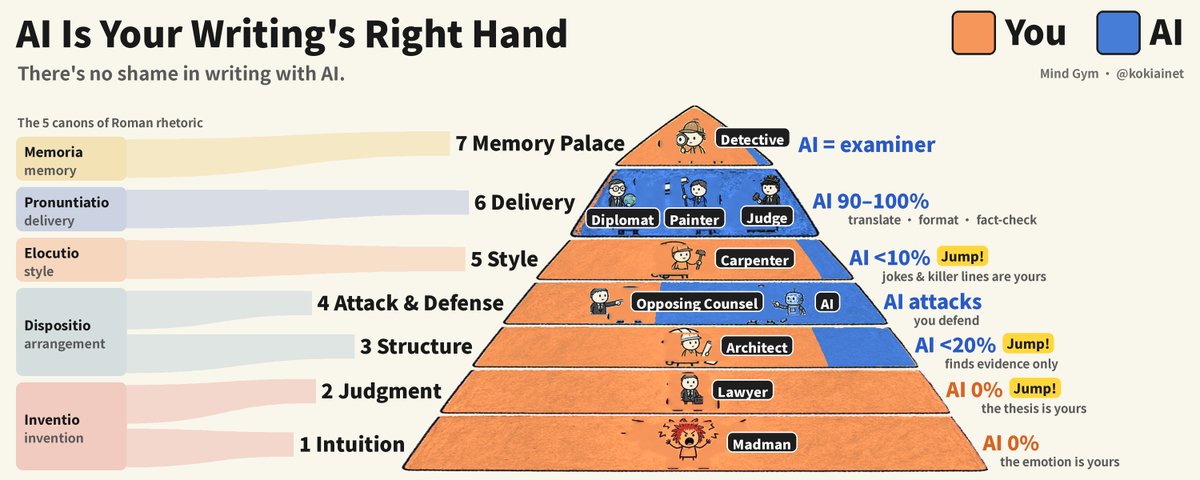
The places marked Jump! in the diagram (layers 2, 3 and 5) are exactly where AI can't help. One of the most human things about us is our ability to connect unrelated things, the way Newton got hit by an apple and thought of gravity. AI is good at small, step-by-step reasoning. And don't tell me about the AI labs announcing they've cracked another famous math problem every other week: the AI the rest of us actually get to use runs at a completely different scale of compute, and what it's good at is the small steps. Humor, killer lines, arguments, metaphors: everything that needs a jump is still on us.
Layer 1: Intuition, the Madman (AI 0%)
The bottom layer is intuition. For me, intuition shows up as anger. A lot of my articles and videos started because something made me angry. Intuition is the Madman, and this is the one layer where AI absolutely doesn't get a say.
Emotion is the thing AI can't replace, and in this era it has become the most precious thing we have.
If your starting point isn't an emotion, your writing will be hollow. If it is, your writing will be real, and in this era only what's real makes people feel something.
Once you have the emotion, you can give the piece a purpose and a topic.
How to do it:
The moment the feeling hits, write it down in one sentence: "Why am I annoyed?" "Why am I happy?"
Get clear on why you're writing this piece.
Compress it into a topic, ideally a decisive statement rather than a question. People like it when someone makes the call for them.
Layer 2: Judgment, the Lawyer (AI 0%)
Once you have a topic, the second stage is judgment: the Lawyer, the Madman's advocate.
The lawyer is the rational voice of the client's emotions. Ask any litigator: clients are almost never rational. Take a divorce lawyer. Today the client says, "I'm divorcing my husband." Tomorrow it's, "He really loves me, I don't want to go through with it." The day after, they're agonizing over whether the kids should live with Mom or Dad. Their feelings change every day; they're the Madman. The lawyer's job is to translate the Madman's demands into a rational case and present it to the judge, who in writing is your reader.
This is where you turn the topic into a thesis with supporting points: one clear main argument with a few sub-arguments under it. That's what makes people see you as someone who argues in good faith. Neither intuition nor judgment can be handed to AI.
How to do it:
Write your thesis in one sentence. If you can't, you haven't figured it out yet.
List your supporting points, as many as you like. Then go back and work out how they relate to each other.
Keep AI closed for this entire step. Your thesis and supporting points are the biggest jump in the whole piece.
Layer 3: Structure, the Architect (AI finds evidence, under 20%)
Next up is structure: the Architect. You've gone from Madman to calm Lawyer, but a lawyer only gives you an argument, and an argument still isn't an article. An article is a building. What the lawyer hands you isn't even a sketch; it's a prompt. The architect has to turn that prompt into a whole building.
If you want that building to be a work of art, an architect has to build it, not AI. AI will only ever build you a Soviet-style apartment block. An architect can build you Notre-Dame, or something baroque.
But AI can pitch in on this layer: it can help you find evidence to back up your points.
What you can't do is list your arguments, write no evidence at all, and let AI find everything. If you don't have enough of your own knowledge and experience, your arguments have nothing holding them up. That's why AI should handle no more than 20% of the evidence.
How to do it:
Put your points in order yourself, and work out at which step the reader will be won over.
Under each point, first write the evidence you already know: things you've seen, things you've lived through, numbers you remember.
Only for the things you half-remember, have AI fill in the details.
You pick through whatever AI finds, and you decide what makes the cut.
Layer 4: Attack and Defense, Opposing Counsel (AI attacks, you defend)
There's another layer, attack and defense, for when you want to write something more rigorous.
Classical rhetoric was mostly about public speaking. Paper was scarce, ideas traveled by voice, and speakers had to keep everything in their heads, which is why they invented the memory palace. When the audience challenged you, you used the memory palace to pull up your evidence on the spot.
Nobody cross-examines you in person anymore; you finish writing and you hit publish. But this layer still matters: you can simulate the cross-examination. Have AI play the audience and challenge you, then marshal your own evidence to answer it. AI can help you close that loop. And because what happens in attack and defense reshapes your structure, I put it under dispositio, alongside structure.
How to do it:
Give your draft to AI and tell it: "You're opposing counsel. List the three objections most likely to sink my argument. Give me arguments, not attitude."
Answer each one yourself, and don't just take on the easy ones. Rebut what you can, and patch what you can't.
If a supporting point collapses, go back to the Architect layer and rebuild. If your thesis collapses, go back to the Lawyer layer and start over.
AI can attack, but it can't rewrite for you.
Layer 5: Style, the Carpenter (AI under 10%)
With the frame up, next comes the Carpenter: the finish work, choosing the words and shaping the sentences.
There are usually two kinds of ornament in a writer's style that you should never let AI write:
Humor and memes: AI is bad at being funny. No joke from an AI has ever made me laugh. Every joke that's cracked me up came from a real person.
Killer lines: AI's quotable lines are painful. Every time I ask it for one, I cringe.
Both are jumps, and only a human can make them.
If you care about speed, don't type the whole thing out, either; typing is exhausting. But not typing doesn't mean letting AI write it for you. It means turning on speech-to-text and saying whatever comes to mind. Typeless or Whisper will do. They'll clean out most of the swearing, typos, slips of the tongue, and grammar problems while keeping about 90% of your original voice.
Killer lines usually come out of conversation, not out of staring at a blank page. A few days ago I was talking with a friend who works in AI about writing for social media. She said that when she writes about stuff that's too cutting-edge, nobody reads it. Without thinking, I said, "Cutting-edge is a vibe." I wrote it down right away, and there was my killer line.
Layer 6: Delivery, the Diplomat, the Painter, and the Judge (AI does almost all of it)
We're not done yet. At the top is delivery, and this layer has three roles:
The Painter, for layout and formatting (AI 100%): your layout and formatting can be 100% AI.
The Diplomat, for translation (AI 90%): I have my own KOKIAI translation skill that makes translations faithful, fluent, and elegant. It can even swap in references from the Odyssey and Homer, so the piece fits each country's cultural context. AI can do 90% of the translation work; you just check the last 10%.
The Judge, for fact-checking (AI 100%): names, dates, numbers, quotes. Have AI check them one by one. A judge rules from the case file, so make it cite the original source for every single item.
Layer 7: The Memory Palace, the Detective
The memory palace: see whether you can rebuild every room of your logic in your head.
Here's how. Close the draft and walk from the first room to the last:
The rooms are your supporting points.
The furniture in each room is your evidence and examples.
The doors between rooms are the logic that carries you from one point to the next.
Wherever you get stuck is where the problem is:
You can't remember a room: AI probably came up with that point for you.
The room is empty and you can't recall the evidence: AI found it, and you haven't digested it yet.
You can't find the door, can't explain why you go from A to B: the structure is broken. Go back to the Architect layer.
On this layer, AI only plays examiner. Have it quiz you on your draft, something like "What's in the second room?" You answer, and it grades you against the original.
Why have this layer at all? MIT ran an experiment in which 83% of the people who used ChatGPT to write their essays couldn't quote a single sentence they had just written. If you can't recall your article, it isn't really yours.
Closing
These days a lot of people think that now that AI is here, we don't have to think anymore, because AI will do the thinking for us. That's not how it works. When food was scarce and people went hungry every day, nobody needed a gym. Now that we eat too well, everyone has to work out. AI is overfeeding us with words and information, and our minds can get fat too. That's why we need a mind gym more than ever.
The mind gym is about values and the life of the mind: not working just for the sake of work, but pursuing the aesthetics of thinking, keeping your mind fit and in shape. Learning how to write with AI is the warm-up.